

Reviewed by the Palmako UK content team with insights from our garden building experts.
If you're like most buyers you imagine that buying a greenhouse is about picking a size and then finding a spot in the garden to put it. But there are actually multiple decisions that have to be made that either turn your greenhouse into a show piece, or an expensive garden ornament.
You need to spend some time planning your greenhouse because those early decisions determine what you grow in it, how long it lasts, and how much enjoyment you get out of it. We help you think through those decisions with our UK buyers guide.
Quick Overview
How to choose a greenhouse is about the most important decisions buyers need to make before purchasing a greenhouse. This includes location, type of greenhouse, size, finishes, and what you want to grow inside the greenhouse. It also includes how to avoid costly mistakes.
Table of Contents
- Location: The most important choice
- Size: Yes, it does matter
- The base: Providing full access for greenhouse gardening
- Greenhouse frames: Metal, aluminium, or wood
- Greenhouse ventilation: Preventing disease and excess humidity
- Greenhouse insulation: Protecting plants in winter
- Greenhouse accessories: Finishing in style
- Conclusion
- FAQs: How to choose a greenhouse
Location: The most important choice

Before you even get to greenhouse types, sizes, and accessories, you need to assess your space’s sunlight. You need a spot that gets the first sun in the morning, picks up the sun during the day, and still gets the last rays in the evening. This would be the ideal spot for your greenhouse.
In the UK, this would be a south-facing area which gets at least six to eight hours of direct sunlight daily. This provides year-round sun exposure, which is ideal even for winter growing. Try to avoid really shady spots because this will prevent your plants from getting the right amount of sunlight that they need for growing.
If you are growing plants that have specific sunlight and watering needs it would be best to plan this before choosing the location of your greenhouse. A north-facing greenhouse will still work, but you will need to adjust what you can grow in it.
Not sure what you want to grow yet? In, ‘What to grow in a greenhouse for beginners’ we look into what you can plant in your greenhouse in every season.
Size: It does matter
For greenhouses, size does matter. You'll be surprised how quickly you'll run out of space in your greenhouse. Don't just think in terms of floor space, but think in terms of growing space. If you choose a greenhouse that is too small, it will soon become a jungle that's difficult to work in. Shelving, access paths and seed trays all reduce the amount of space you have to work in.
Once you work out what you want to grow in your greenhouse, and you're stuck between two sizes, go for the bigger size; you'll never regret that you did. It's a helpful idea to mark out the space that you have for the structure and the size you're looking at before you commit to buying anything. This will help you visualise whether you are going to have enough space.
Don't forget you need enough space to move around and work with your greenhouse plants. Smaller greenhouses are still wonderful, but you will have to adjust your expectations about how much you can grow inside them.
When working on the location and size of your greenhouse, consider leaving enough room around the structure to lay down paving. This will be helpful during regular maintenance when you're cleaning the glass, and to avoid having mud all around your greenhouse during the rainy months.
Top tip from the Palmako experts: Buy the biggest greenhouse that your budget allows, and you won’t have to upgrade after one growing season. Speak to a Palmako expert and let them help you make the right choice from the start. Their unique shed-greenhouse combos might be just what you need - saving you space and the cost of buying each one separately
The base: Providing full access for greenhouse gardening

With location and size sorted, you come to the third most important decision. The base of your greenhouse is all about access, and what kind of plants you want to grow. Most greenhouses are a combination of soil and concrete pavers, but gravel is also becoming more popular.
Think about access, drainage, and what your greenhouse will be like when you’re fully into the growing season and plants have everywhere. Drainage is more important than most buyers think. You don’t want to create a muddy mess every time you water your plants, causing water to pool and go stagnant. This is a breeding ground for insects, and other organisms that can harm your plants.
A combination of soil (for plants with deep root systems), gravel (for drainage), and concrete slabs (for walkways) is the ideal base for larger greenhouses. Also, the base inside the greenhouse doesn’t need to be the same as what the structure is resting on. A level surface is required for this, and can be a concrete slab, or pavers. Get the structure anchored on the correct base first, and everything inside will work much better.
Greenhouse frames: Metal, aluminium, or wood
Much like the human spine, the framework is the structural backbone of your greenhouse. Buyers usually choose between aluminium frame greenhouses, wooden frames, or other types of metal frame structures, each with its own advantages.
- Aluminium frame greenhouses: The most common choice for UK homeowners, they are lightweight, corrosion-resistant, and require very little maintenance. With the correct maintenance, it can last decades. Paired with toughened glass or polycarbonate panels, they create a durable and low-maintenance greenhouse suitable for beginners and experienced gardeners.
- Wooden frames: When homeowners prefer a natural look, they go for wooden frame greenhouses. They provide a slightly warmer internal temperature wherever wooden structures require regulator treatments to protect them from moisture, rot, and insect damage.
- Metal frames: Some greenhouses are built with metal frame structures made from steel or reinforced alloys. These frames are extremely strong and are used for larger greenhouses or gardens exposed to strong winds.
Greenhouse ventilation: Preventing disease and excess humidity
Even in the UK, greenhouses can overheat quickly in the summer months. The excess heat and humidity won’t be good for some plants, and so you need roof vents, louvres (side vents), and wide-opening doors to ensure adequate ventilation.
Opening vents will allow you to control the temperature inside the structure and let out any stale air. This is important for controlling plant pests and diseases that thrive on moisture and heat, such as fungi. In winter, these vents allow you to retain warm air, reducing heat loss, and still bring in fresh air. Plan the structure to give you easy access to both roof vents and side vents.
Top tip by the Palmako experts: Go for a greenhouse with automatic openers that offer smart ventilation. These thermally powered roof vents open and close based on the temperature, without any electricity. See for yourself what this looks like with Palmako’s Emilia S Compact Greenhouse.
Greenhouse insulation: Protecting plants in winter

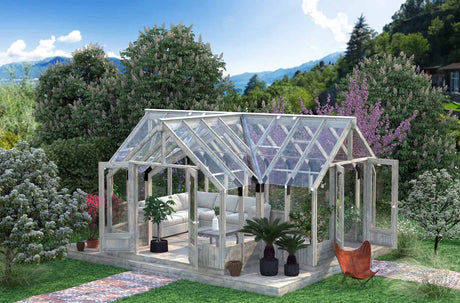
Both ventilation and insulation have made it onto the planning list because they make a huge impact on plant failure. A modern, new greenhouse with quality framing and tempered glass panels, for example our glass greenhouse, will do a better job of retaining heat than older greenhouses.
During autumn and winter, some homeowners like to put bubble wrap on the inside of the greenhouse to prevent heat loss. This clear plastic still allows light into the greenhouse, but protects the plants from cold weather and nighttime low temperatures. If you’re experiencing a really cold season in your region, then a combination of bubble wrap and a paraffin heater will provide young plants and temperature-sensitive plants survive.
Can you grow anything successfully in winter? Yes, quite a lot. Find out what you can grow in, ‘What can I grow in a greenhouse in winter?’
Greenhouse accessories: Finishing in style
The accessories are like fine pieces of jewellery that finish off an outfit. How you place them can either make or break whether your greenhouse works as a unit or not. Greenhouse staging is an important part of the accessories. Placing shelves and worktops in your greenhouse provides space for growing seedlings and working inside the structure.
Next, you can add baskets, hanging pots, trays, and small shed boxes for tool storage. Purchase tray racks for germinating seedlings, so that you don’t have to find an additional space to do this. This keeps everything neat and tidy, and makes greenhouse gardening more enjoyable.
Conclusion
Before buying a greenhouse, there are multiple important decisions you should make. These early decisions will help you avoid common buying mistakes homeowners make when choosing a greenhouse. By carefully considering elements like the location, size, structural frame, base, ventilation, and insulation, you will get the maximum enjoyment out of your new greenhouse.
Greenhouse suppliers offer free and expert advice once you’ve made the important decisions, so don’t hesitate to approach a number of suppliers and let them guide you through their product range until you find what you’re looking for. Testimonials are another great way to narrow down your choices.
Armed with this buyer’s guide, you’ll have the confidence to find a greenhouse that will give you years of greenhouse gardening joy.
FAQs: How to choose a greenhouse
1. Are cold frames referring to a greenhouse structure?
Cold frames are referred to as miniature greenhouses. They are made from glass or transparent plastic, but have no bottoms, making them ideal for protecting plants that you want to plant directly in the soil. They keep frost, rain, and snow off plants, and are often used as a transition space to ‘harden’ seedlings before planting.
2. Are aluminium greenhouses the best?
Aluminium greenhouses are very popular in the UK. They are strong and durable, withstanding a range of adverse weather conditions. They last many years with the correct care and maintenance, and are a reliable choice for both beginners and experienced gardeners.